

Profile: Maddison Woollard
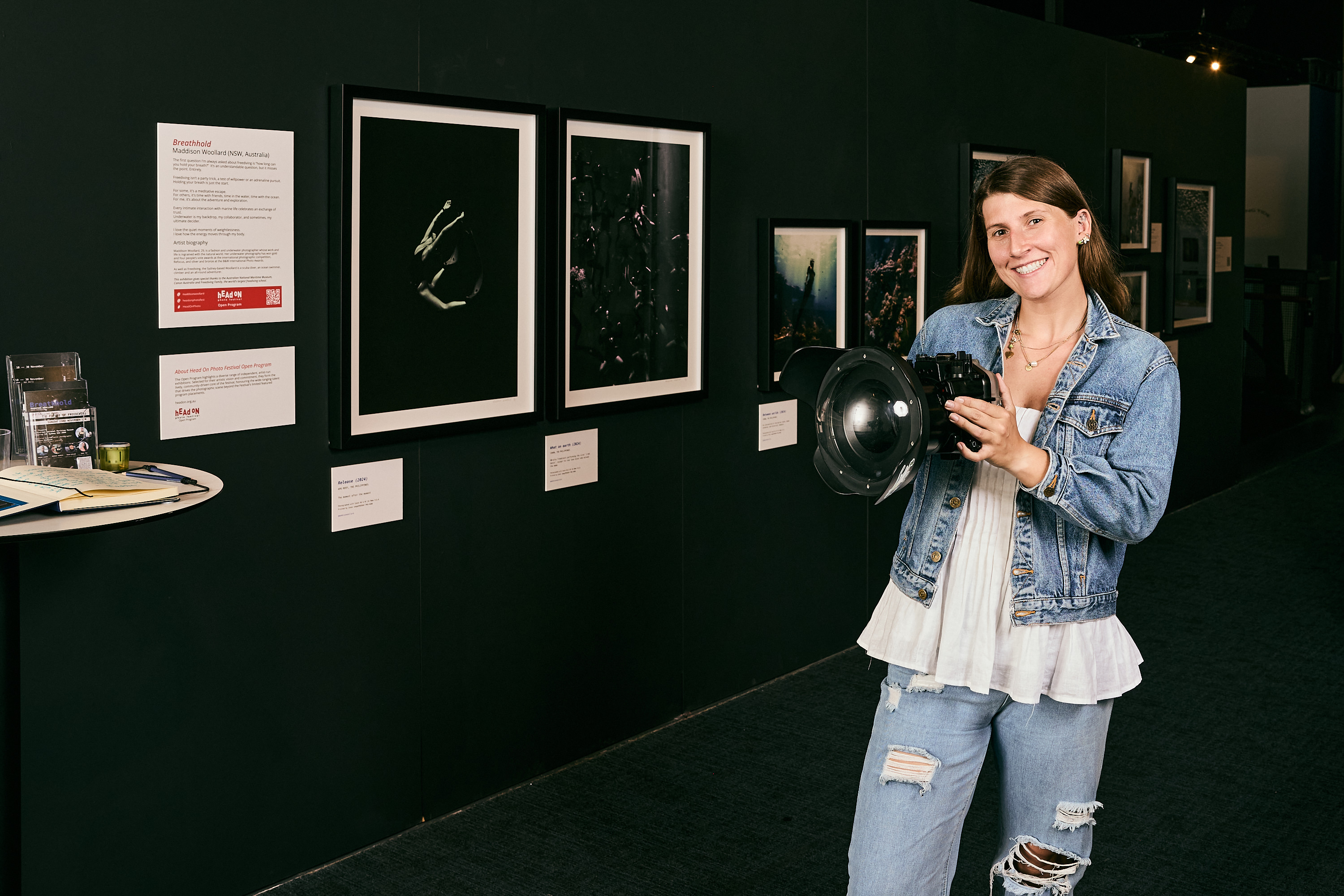
Fresh from exhibitions at the Australian National Maritime Museum and Lunar Studios, Sydney photographer Maddison Woollard is making waves in the challenging genre of underwater photography.
We sat down for a chat with her to discover the secrets behind her amazing imagery.
Australian Photography: What first drew you to underwater photography, and how did you get started in such a specialised field?
Maddison Woollard: To be honest, it was something I pushed against at first. When people heard I started diving, the first question was always "do you take your camera underwater?" — and I was like, guys, I just want to dive!
There is also a lot of specialised equipment involved that you really need to get your head around. So for the first year I just focused on being a good diver and enjoying the discovery of the ocean, I didn’t anticipate falling head over heels.
After about a year of freediving and scuba, the quality of my action camera didn’t cut it for me anymore and I started getting the itch. Luckily there are some budget housing options available now, so for me, it was a small investment to see how it went.
And this is how it's going.
AP: How does shooting underwater change the way you think about composition, light, and storytelling compared to land-based photography?
MW: Shooting underwater alters how I think in many ways. The main one for me is having to truly embody that nothing is up to you. Coming from fashion and advertising, where you control everything, that was really challenging at the beginning.
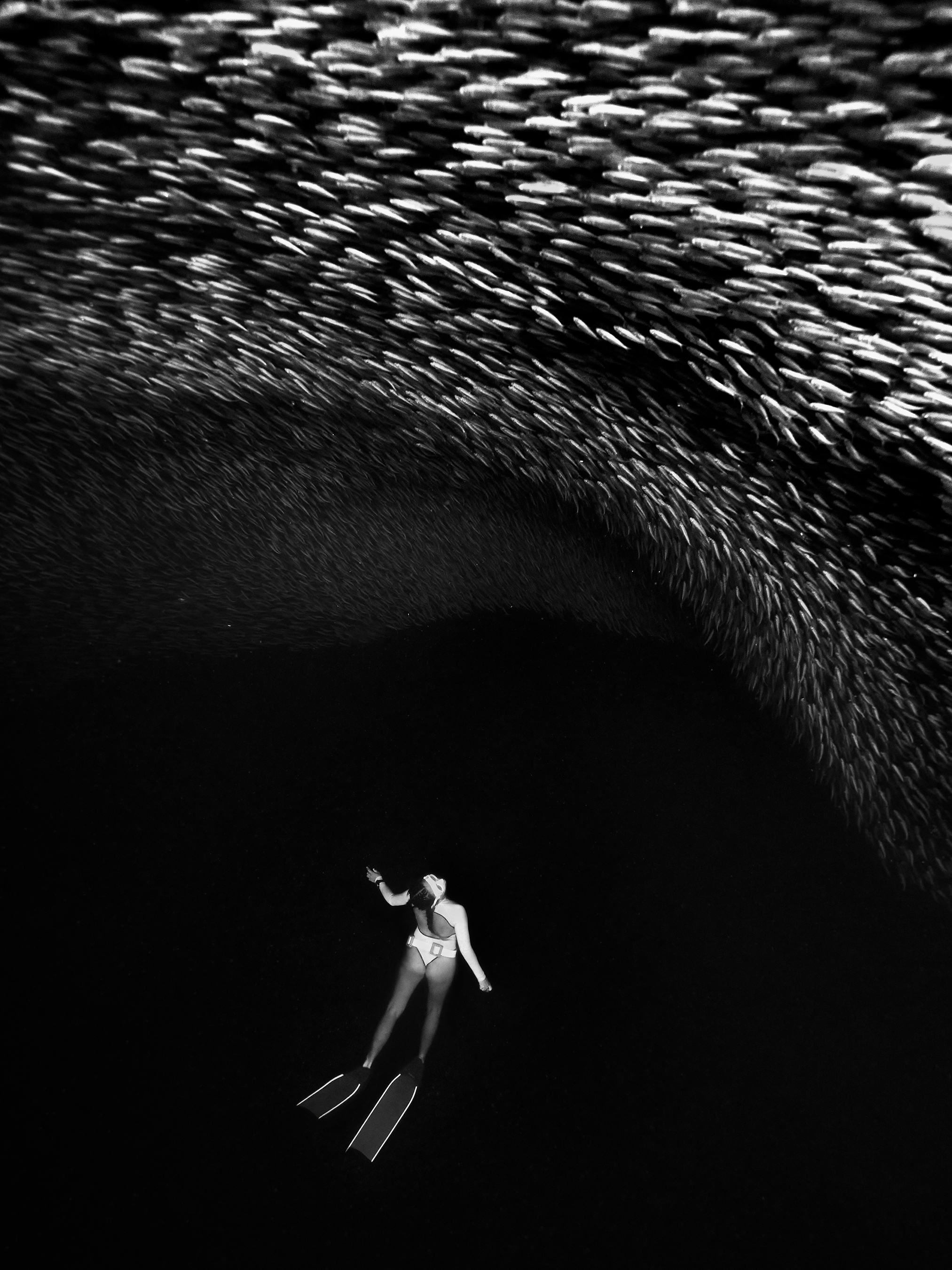
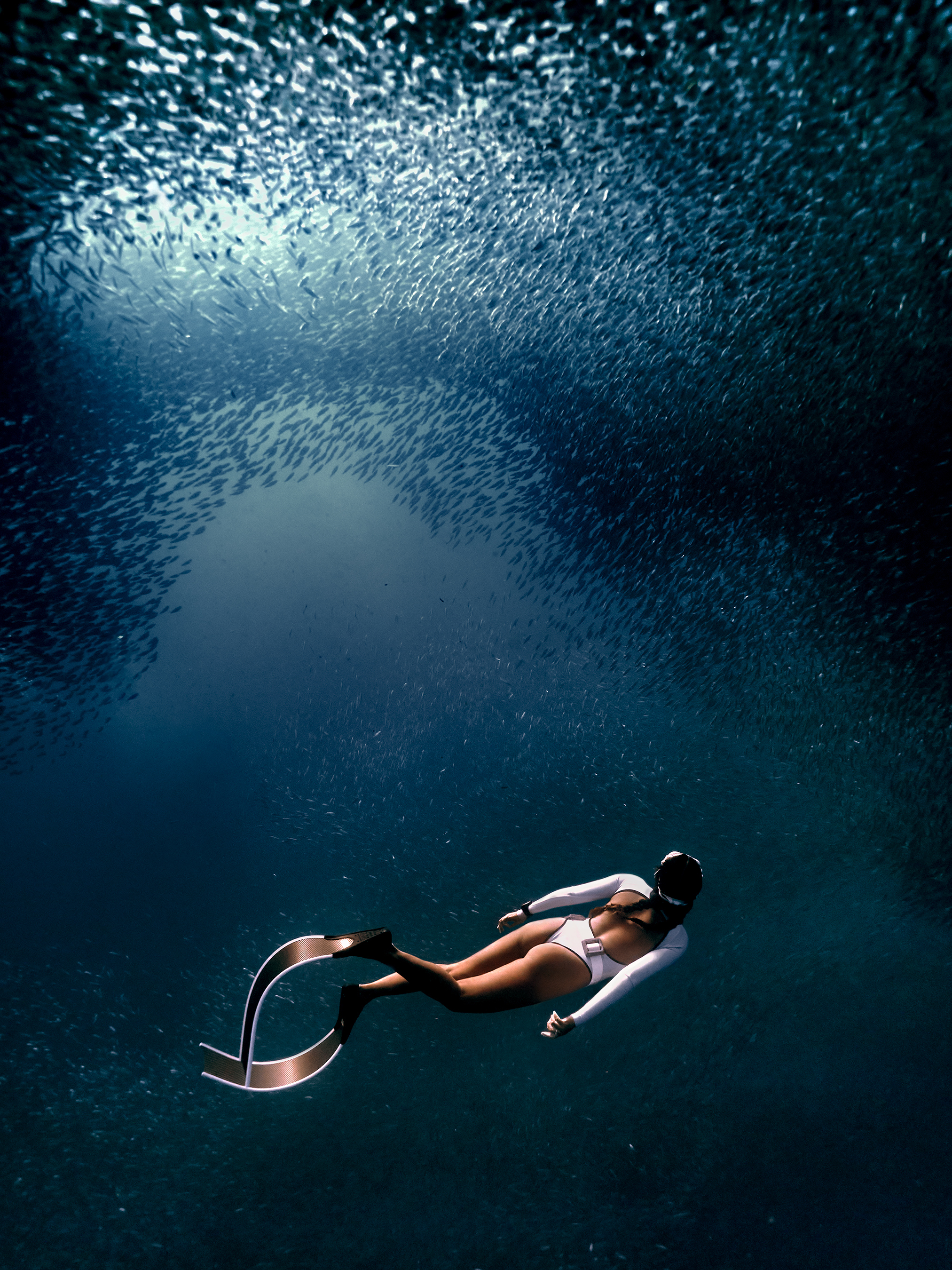
I remember early on going out to shoot inside bait balls with a friend and getting really frustrated because you can't direct fish, clearly. I was trying everything to encourage their movement in a particular way, I changed my approach, my model’s approach, and it just wasn't happening.
At some point I had to flip my mindset, what can I control? My angle. My positioning. How close or far I shoot. I started focusing on that and letting the rest go.
It still gets on my nerves - not going to lie - but it's a skill in itself to still be at your best when you can’t prime your situation.
Light is probably the biggest difference from shooting on land. I've deliberately chosen not to use flash because it’s not my vibe underwater, so I'm entirely reliant on the sun.
You've got full sun or overcast, it’s coming from above, that's it.
In the water the more sun the better, you lose so much light as it enters the water. Full sun is always best, I generally always want my models head up towards the surface/sun, then move around depending how I want the shadows to fall. Or none at all, and have a silhouette.
It actually takes me back to when I first started out shooting on the streets with just a friend and a reflector, you work with what you've got. Composition-wise, I have a similar tendency, I love to shoot wide and capture everything.
You lose clarity shooting through water, so you really want to be as close as possible, which lends itself to a wider lens anyhow. I want to play more with shooting more details. Storytelling though, I think that's parallel to what I do on land.
I believe if you choose to shoot across multiple genres you need a distinctive style that threads through all of it, so that a photo of a whale and a photo of a model in a studio should both feel like they were taken by the same person.
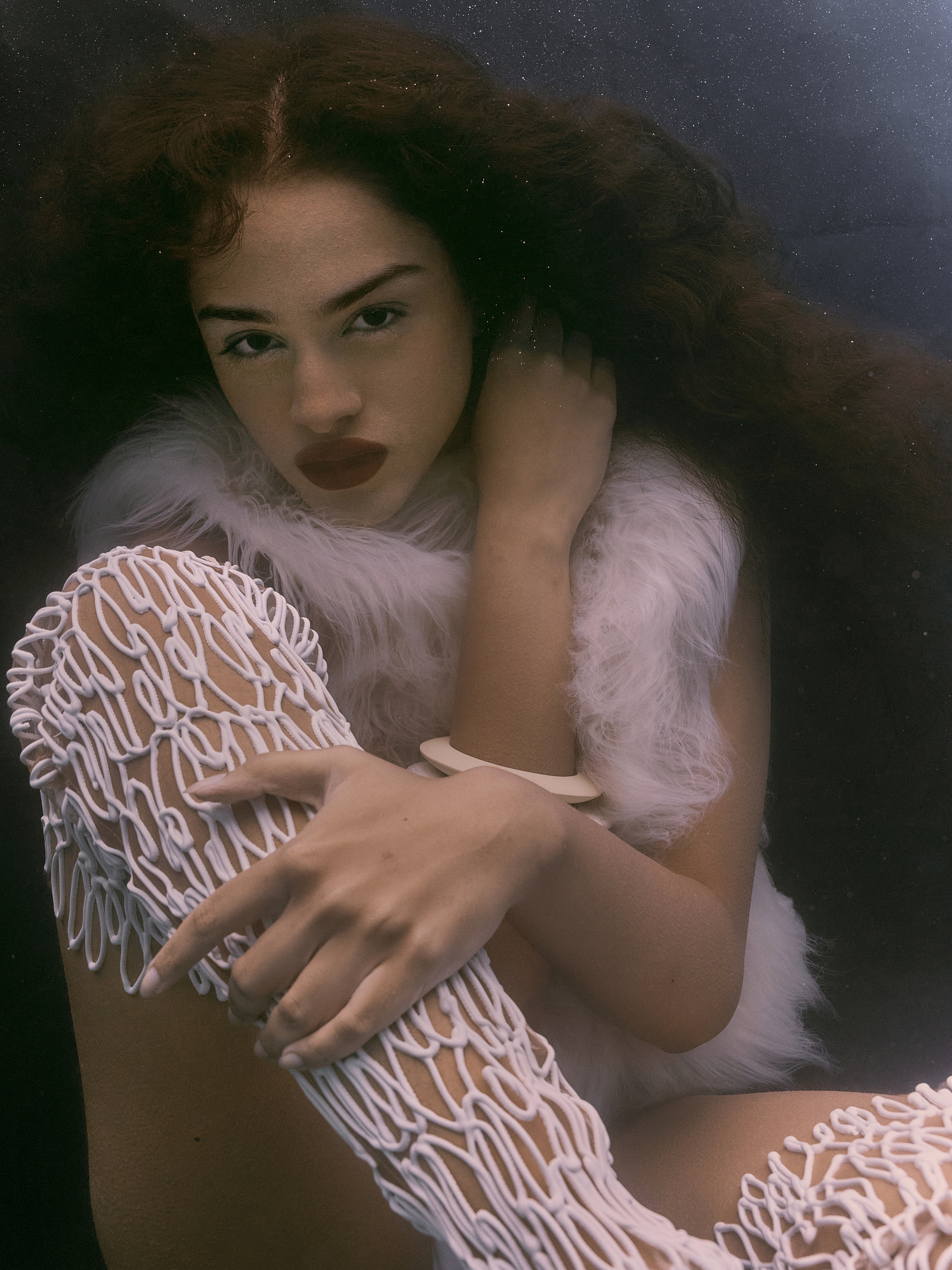
That's something I really strive for. I'm also starting to bring fashion into my underwater work, so bringing them together feels really special.
AP: What have been your biggest technical challenges when working underwater—equipment, visibility, or working with subjects?
MW: All of the above, in different ways. As a professional photographer, it wasn’t like I was learning photography at the same, the transition was more about learning the logistics of the housing and different ports, training my brain on where all the buttons are now, to churn it to the right buoyancy, and then understanding what water itself brings to the equation.
The main thing is you're doing two intense activities simultaneously. Most of my work is freediving, I shoot scuba for deep wrecks or smaller things, but I prefer freediving when working with people, and it means I’m under the same conditions as them.
So I'm holding my breath, keeping my body in check, thinking about the composition, while analysing my surroundings, trying to construct a shot in a matter of seconds with a model I can't speak to, who in some cases can't see me and definitely can't hear me.
There's a lot happening. A lot of de-briefing on the surface, a lot of chatting beforehand, then you both dive and things just unfold. Framing up is at the forefront of my mind, I’m trying to control my position and buoyancy, my angle, sometimes I’ll change my mind mid dive and have to reorient without being able to communicate that.
That's actually what I love most about it now.
This moment will never happen again and look what we made with it. In fashion and advertising, if something's not quite right you can try again. Underwater, that exact moment is gone forever, and that's what makes each capture so meaningful.
As frustrating as it can be creatively, there's so much more weight to what you're making.
Visibility I've learned to just roll with. The more I shoot, the more I only want to go out when conditions are good because it does make all the difference.
But sometimes, especially when travelling, it's what you've got, and it's important you have experience in those conditions rather than throwing the towel. That's the ocean. You don't know what it's going to serve you on the day, I believe it’s important to embrace that.
Working with subjects underwater is just its own thing entirely. You are all floating in a new environment, that’s new. You need a lot of patience in hope what you waited for, happens. You can’t speak to either a seal or a human underwater, it's more observational than directed.
There is actually something freeing about that when you know you can’t ask a cuttlefish to change colour again so I can change my angle. It’s all about how your instinct shapes up under pressure and in that heightened state of “this is it.”
AP: Can you walk us through what a typical shoot looks like from planning to execution? How much is pre-visualised versus improvised?
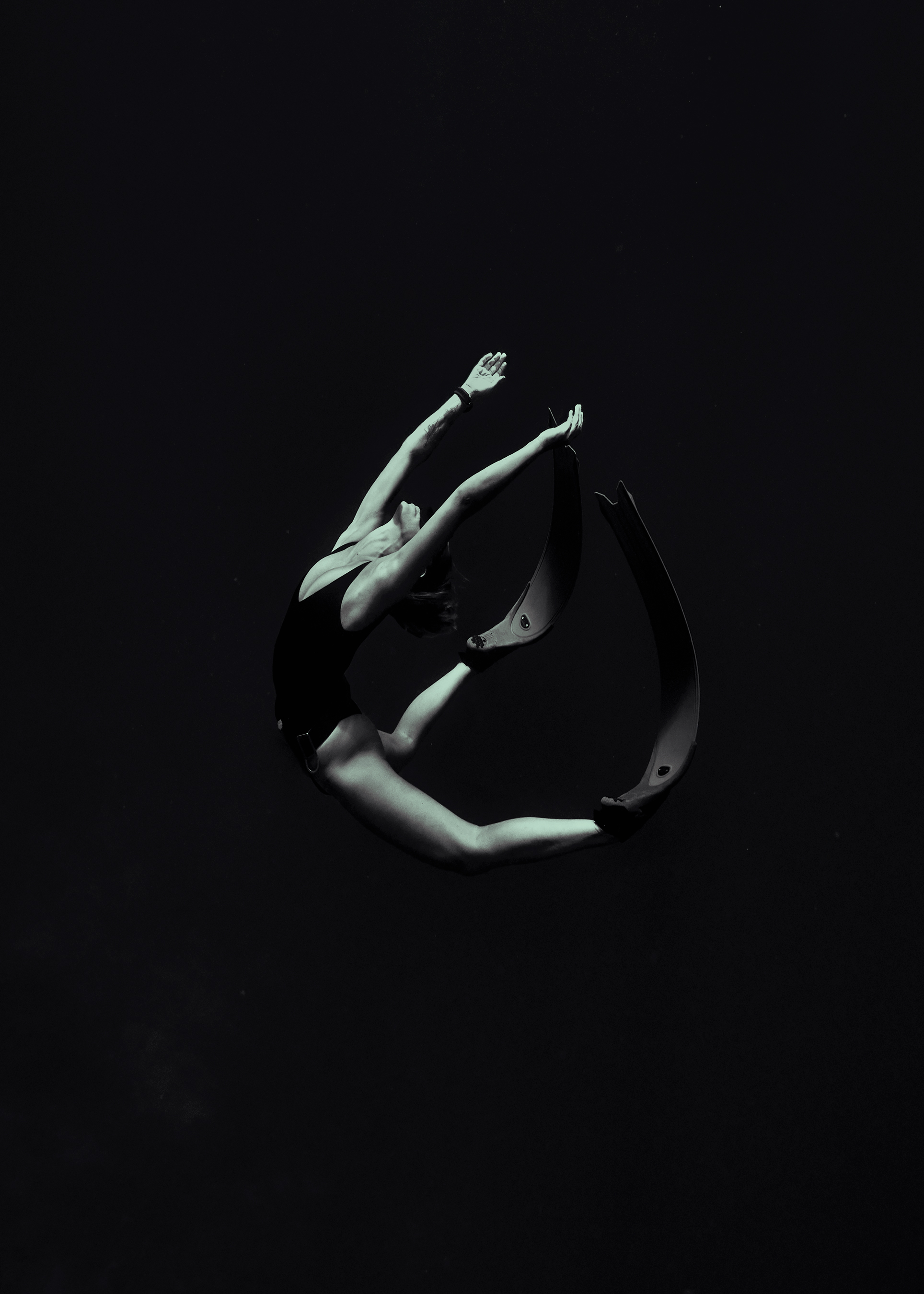
MW: The more I shoot underwater, the more planning I try to bring to it, but that's not how I started. My series Breathhold, which showed at the Australian National Maritime Museum, wasn't planned at all.
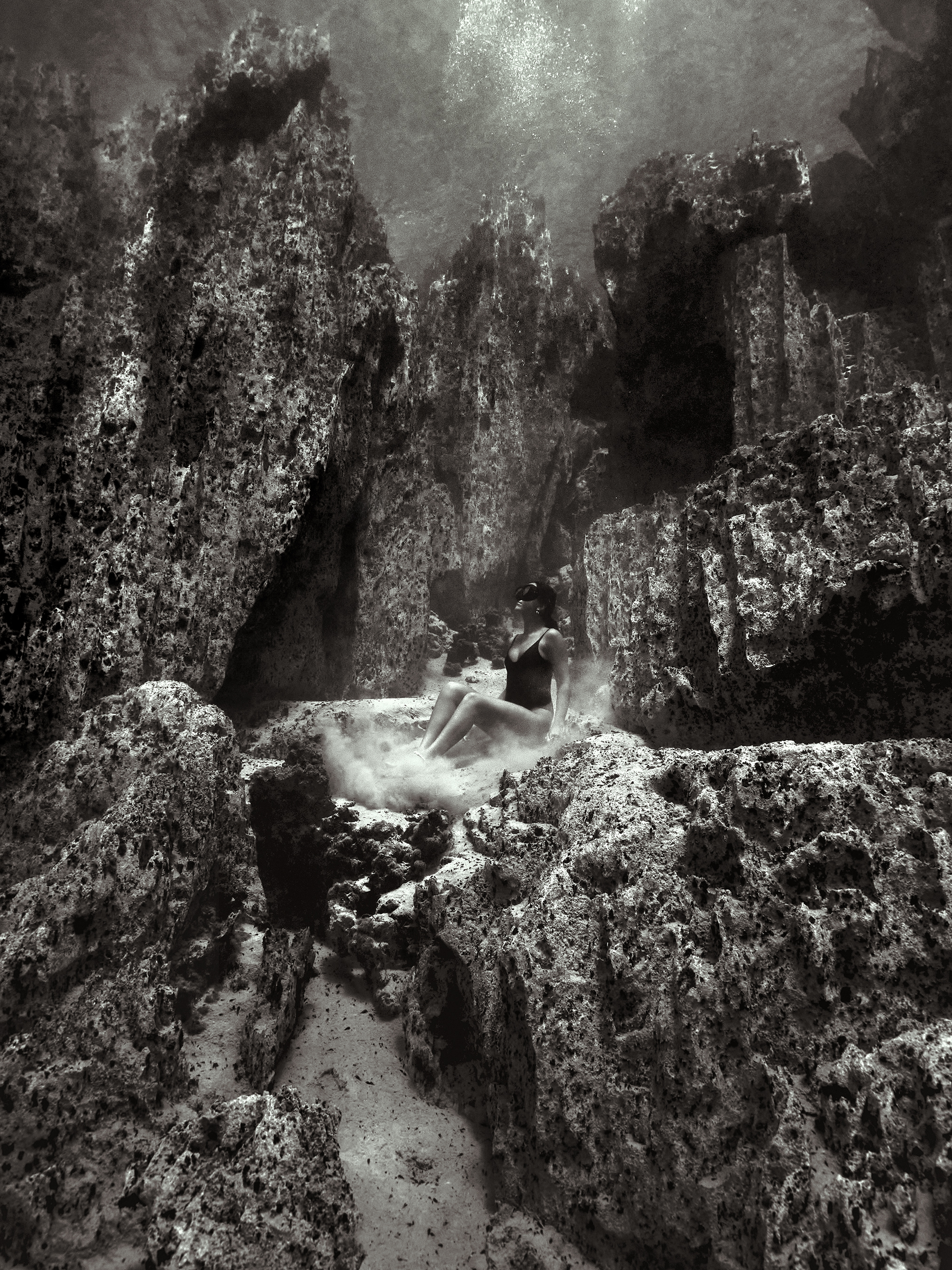
I was on my very first freediving trip in the Philippines, actually there to get my level two certification, which, spoiler, I didn't end up getting. It was a challenging week, I wasn't in the best headspace, so I switched my focus to photography. I just purchased my housing and what a perfect place to try it out. I had no real vision beyond a few locations.
At that point I didn't see underwater photography becoming serious work for me, so it was one of the only times in my career where I genuinely felt no pressure to excel. In terms of what I do plan before a shoot, if my model is diving, they need to be a certified freediver.
You can't take just anyone out into the ocean, people are holding their breath in weird positions, maybe diving some depth, you need to know they're trained, both for their safety and your own.
You’re budding each other. Today I go in with more of a story in mind, particularly as my portfolio grows and I'm always trying to do something different to what I've done before.
My intention is clearer. But embracing what happens on the day, that part is exactly the same. I brief the model on the location and any visual references. A lot of collaboration and improvisation.
AP: How do you build trust and communication with your subjects when they’re underwater and often out of their comfort zone?
MW: The most important thing here is that I don't work with anyone who's out of their comfort zone, because if they are, you can see it instantly, and it takes you out of the image.
I actually need them to be as comfortable as possible, tension is visible in the body, and sometimes it is irritable - if their mask is off, there’s salt in the eyes, water in the nose.
If there is no fins they are working so much harder, they may be in an awkward position. It’s a demanding role. Most of the trust is built before you hit the water. If they're already a freediver I often know them, which is the best case scenario. In the ocean as freedivers you’re each others safety divers, refresh protocols, like never forget your 3 recovery breaths!!
You need to know each other’s limits and keep that communication line open should it change. Refresh the key hand signals. For commercial jobs in a pool where it’s not a freediver, I do a test with the model in the water well ahead of the shoot day.
For fashion portfolio shoots with models, you don’t usually have that luxury, so it's really just about being direct from the start. Asking about their underwater experience, how comfortable they are opening their eyes, with water up their nose, holding their breath for a few seconds, being in cool water - being really transparent about what I'm going to ask of them.
If there’s any hesitation, then it’s not the right fit for either of us, and that’s totally okay. Showing images we take as we go helps too, they gain confidence and get excited that the effort is worth it.
Being hyper aware of how they are feeling, if we come up and either of us look bugged, we rest.
Checking in makes the shoot flow. Ultimately though, the shoot comes down to who you are as a person. Your energy and how you make people feel, that's what creates a safe space.
AP: What’s your favourite image you’ve captured?
MW: That's a really hard question, and I love that it's hard! I'll give you two: one with people, one with marine life.
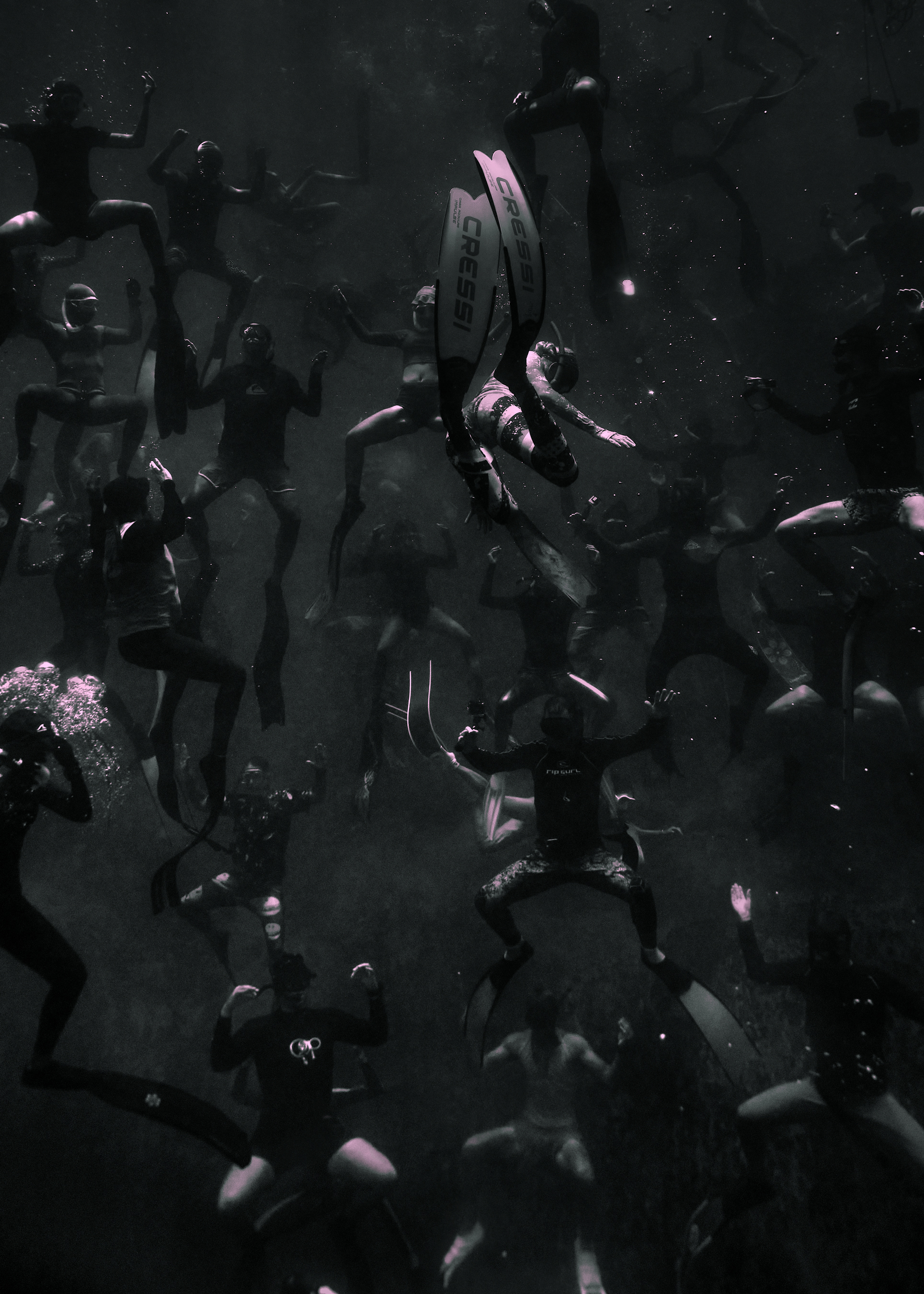
With people, it's What On Earth — a shot of over 80 freedivers doing the crab dance at the same time. It's black and white, which is unusual for me. It's graphic, strange, chaotic, it represents my brain and what I’m about in the best way.
You generally think of marine life when it comes to the ocean and those once in a lifetime moments, I think it’s so cool to feel I have that in human form. With marine life, it's No Fluke, a humpback whale from Tonga.
When I got back on the boat and showed one of the guides, he burst out laughing, he thought it was a terrible photo (by conventional standards) hahaha. It’s the underside of a female whale; there are water droplets on the lens, the sky is blown out because it was overcast, the sea was rough.
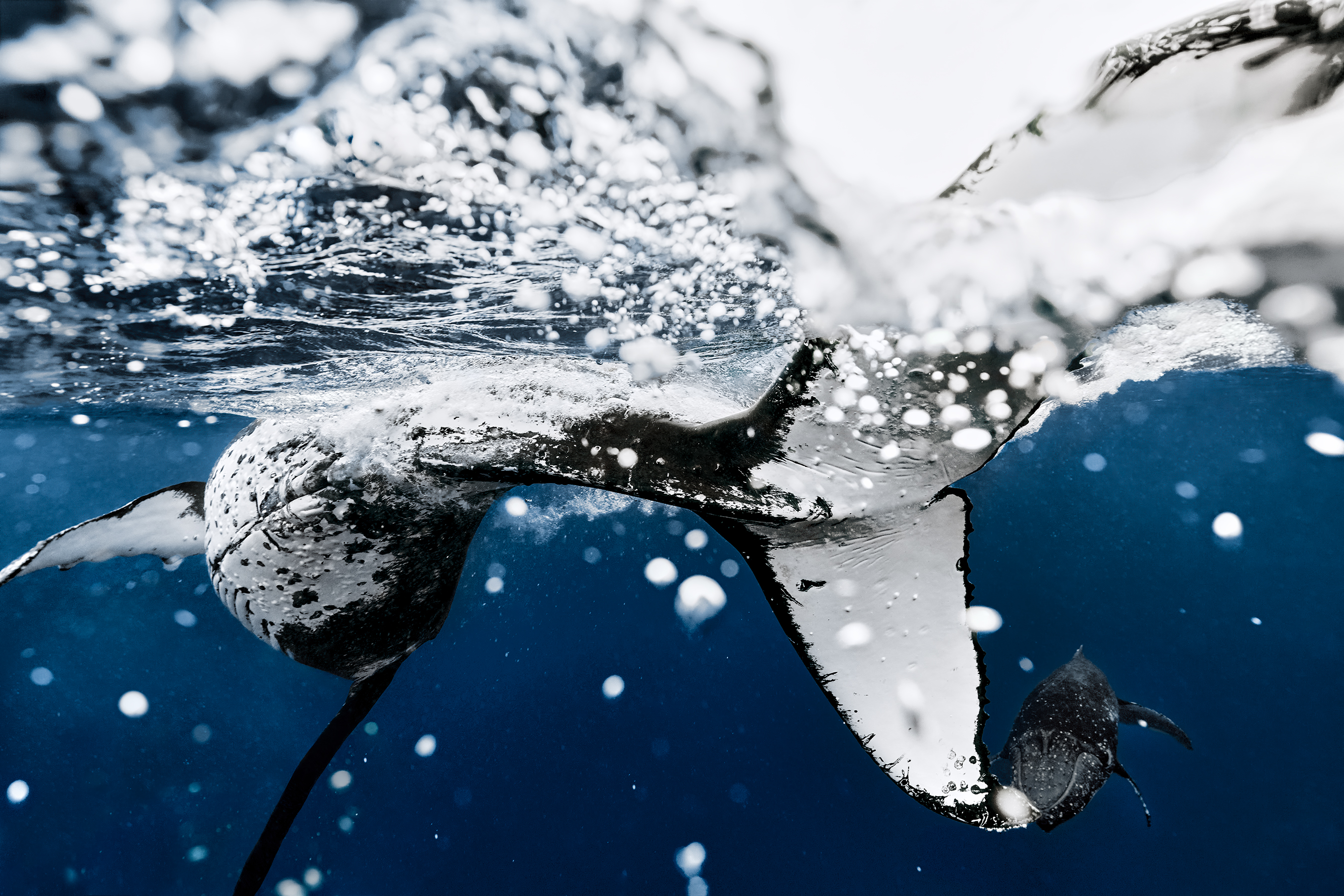
But here's what happened: she'd been dancing parallel to us with her male escort below and then turned suddenly right in front of us. Humpback whales are so smart, they will duck their peculiar fin to go underneath you as they pass, but they have no eyes on their fluke.
Being my second day, I was still learning how they tend to move and I was so locked in on my camera screen. I was on 15mm so I didn't clock how close she actually was until I felt my guide pull me back.
I moved the camera and her tail came around, you felt the sheer strength of her through your body. I held the trigger down as we both kicked away, I only got about ten frames, and in nine of them my fin is in the shot. That's how close we were. My adrenaline was pumping.
Split shots are hard enough on a calm day, and it was in focus with water splashes. The image is so dynamic, full of energy, you can feel the movement, power, mayhem. I went into that trip with a real intention, I just wanted to take whale photos that I hadn’t seen before.
You can only get so close, the whale moves how it moves and they are so big, I realised how genuinely hard to get something that feels different.
I remember how stoked I was in the moment, because I thought whatever I take this trip, how can I get anymore Maddie than that?! That’s the similarity between both of these shots, I see me in them. It can’t get better than that.
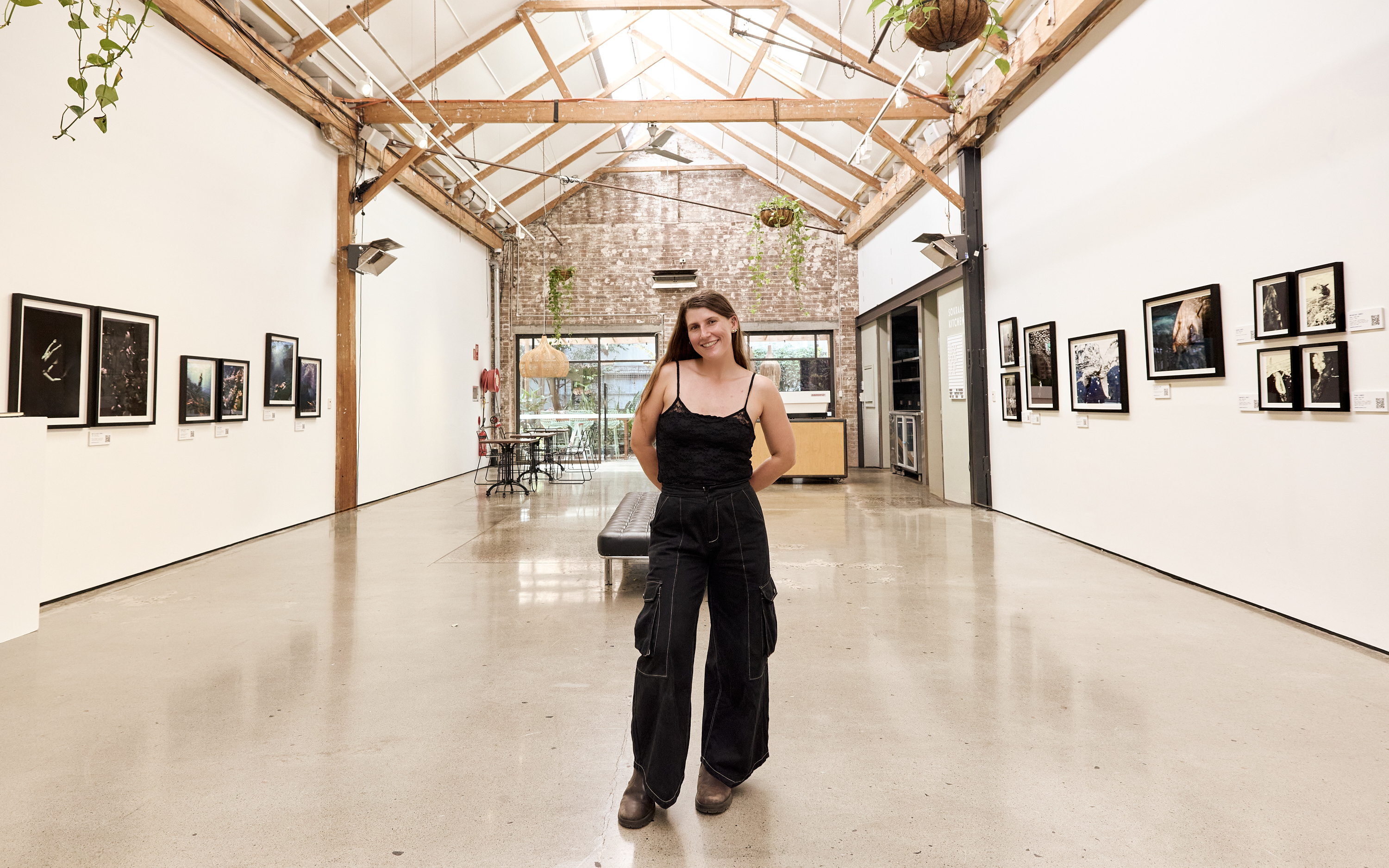
You can see more of Maddison's work on her website and Instagram.