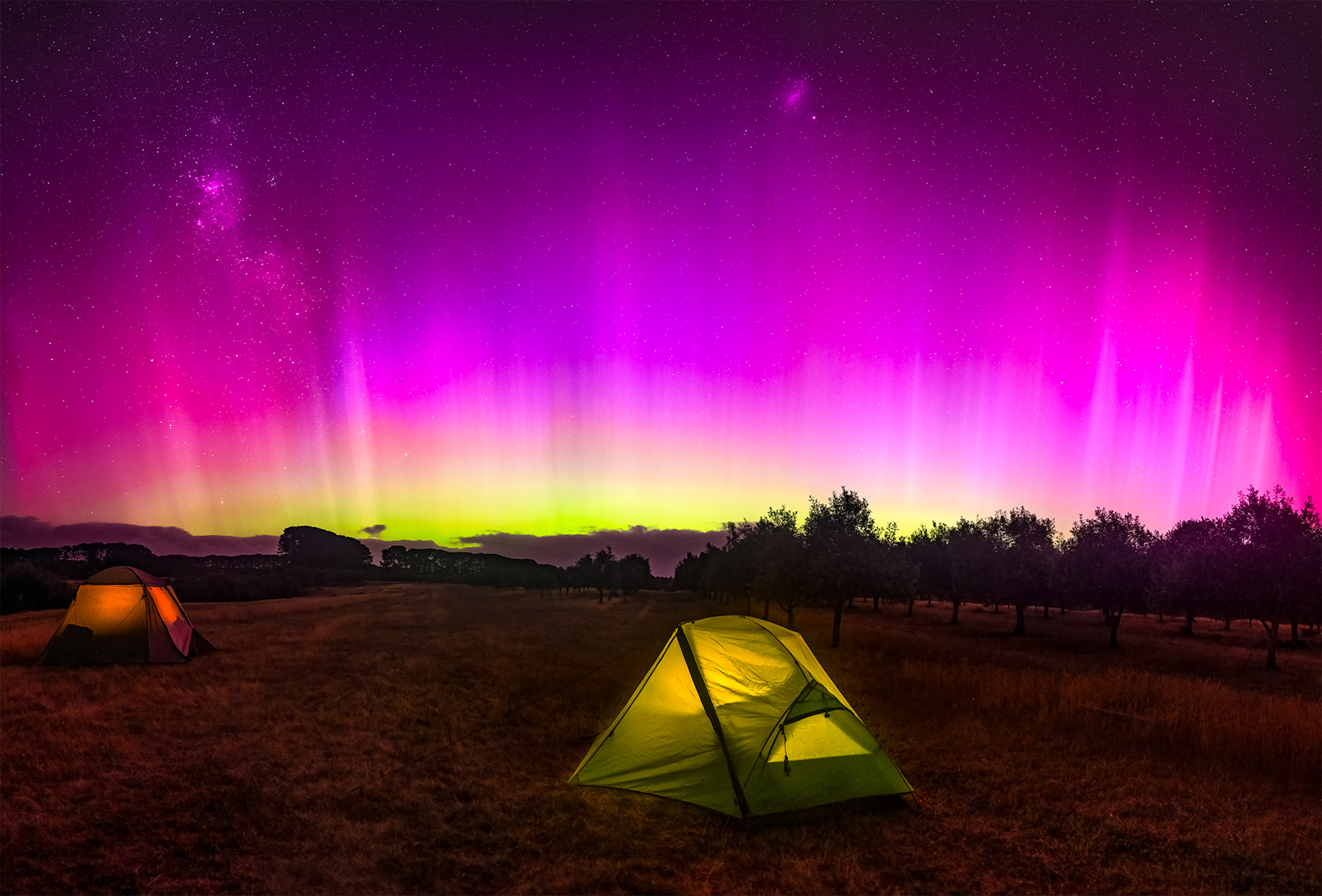
Travel photography blog Capture the Atlas has released the eighth edition of its annual Northern Lights Photographer of the Year, with two Australian photographers, Jeff Cullen and Sara Aurorae, earning places in the 2025 top 25 for their Aurora Australis images captured in Victoria.
“Gibson Steps Aurora” – Jeff Cullen Great Ocean Rd, Victoria, Australia I had been struggling to find the motivation to get out and shoot. The aurora was predicted, as were the clouds, but I decided to take the chance and drive the hour to this iconic destination. The cloud prediction was correct, but I still went down the 86 steps to the beach and crossed the sand to the Gog and Magog sea stacks. The clouds started to clear, and I was able to shoot some great images before the aurora died down. I packed up and had another nearby destination in mind. Climbing back up the stairs, the beams were so big and bright in the corner of my eye! I ran back down to the beach and quickly set up my camera again. This image shows the magic that happened that night; I was absolutely amazed and astounded that such a weak aurora forecast brought me such a brilliant show.
Their work reflects a year of unusually strong southern lights activity that pushed deep across Australia during major geomagnetic storms.
“Celestial Fireworks on New Years” – Sara Aurorae The Otways, Victoria, Australia On New Year’s Day, beneath the dark Australian sky, my friends and I were met by celestial fireworks with the Aurora Australis unfurling in a sudden, breathtaking bloom above our quiet campsite in the Otways of Victoria. Ribbons of rose, violet, and green shimmered, visible even to the naked eye, as if the universe itself had heard our resolutions for 2025 and joined in our celebration.
Published each December to coincide with peak aurora season, the curated collection brings together 25 standout images from photographers representing 15 nationalities.
This year’s images span locations across Iceland, Norway, Finland, Greenland, Sweden, the United States, the United Kingdom, Australia, and New Zealand.
“Fiordland Aurora and Lupins” – Douglas Thorne Cascade Creek – Fiordland, New Zealand This was an aurora that just kept on giving all night! I was at Cascade Creek in Fiordland, New Zealand, admiring the natural beauty of the rugged forest, dainty wildflowers, and bubbling stream. I had an idea of getting the purple lupins in the foreground with the Aurora behind, but I didn’t know exactly where the flowers were at the time. This particular shot was taken at my second location for the night, as my first stop had barely any lupins showing. I spent quite some time walking up and down this area to find this composition, and in the end, it was well worth it.
The 2025 edition follows another exceptional year for aurora chasers. Although the solar maximum has now passed its peak, geomagnetic activity remained remarkably high throughout the year, producing widespread Aurora Borealis and Aurora Australis displays, including rare sightings from long-haul flights crossing high-latitude airspace.
Editor Dan Zafra compiles the list throughout the year, selecting images for their technical quality, the story behind the shot, and the sense of inspiration they offer.
“Frozen Silence Beneath the Lights” – Nikki Born. Riisitunturi National Park, Finland. This night was truly unforgettable. Capturing the famous frozen trees of Riisitunturi beneath the Northern Lights had been a dream for years. In March 2025, we set out to make it happen, but the weather challenged us with thick clouds all week. On our final night, we hiked into the park, hoping for a glimpse of the sky. The wind was biting, and we took shelter among the frozen trees, waiting in silence. After hours of nothing, we finally gave up and began the hike back to our cabin. Then, just as we were about to call it a night, a break appeared in the clouds. We grabbed our gear and hurried back up the Riisitunturi Hill. The moment we reached the top, the sky burst into vivid shades of green. It was an explosion of light and wonder.
The project aims to highlight both established aurora photographers and emerging talents, as well as images from less commonly photographed locations.
Capture the Atlas is a travel and photography blog that focuses on landscape and astrophotography, offering guides, tutorials, and resources for photographers at all levels.
You can see more winners on the Capture the Atlas website.
“Lights & Ice” – Tori Harp Aoraki/Mt Cook National Park, New Zealand I originally found this ice cave, called a moulin, 8 months prior to setting up this shot in Aoraki/Mount Cook National Park. Glaciers are a very dynamic environment, so I kept going back to monitor the changes of this moulin over the 8-month period. As the opening of the cave formed, I envisioned setting up a night shot with my friend abseiling down the mouth of the cave with New Zealand’s amazing starry sky in the background.“Neon Nightfall” – Andres Papp Türisalu, Estonia I shot this image on a quiet, rocky beach as a strong aurora storm rolled in from the north. At first, it was just a low green arc, but it quickly erupted into vertical curtains of lime and rare magenta. To connect the sky with the foreground, I illuminated the shoreline rocks with a strong 365 nm UV light torch, which made the minerals pop and added the surreal glow you see in the image.“Celestial Fireworks on New Years” – Sadeq Hayati Raufarhöfn, Iceland These days, a mobile phone isn’t just a communication device – it’s a window to the universe! In addition to accessing the online encyclopedia of humanity, today, it can also introduce us to the world beyond our planet! This photo is a single-shot capture from Iceland, taken with my Samsung mobile phone in Pro mode, with an 8-second long exposure. It shows the “Arctic Henge” (Heimskautsgerðið) in Raufarhöfn, Iceland.“Llangrannog Aurora” – Mathew Browne Llangrannog, Ceredigion coast, Wales I was overjoyed to capture this otherworldly Northern Lights display on the rugged Ceredigion coast of West Wales. The village of Llangrannog is not known for its celestial displays; it is better known for its beach, dramatic cliffs, and the statue of St. Crannog, who stands watch over the shoreline. Because sightings of the aurora in this part of Wales are so uncommon (this location lies 52 degrees north), each image I’ve captured is an intersection of preparation, great timing, clear skies, and, of course, a bit of luck.“Twisting Turn” – Virgil Reglioni Scoresbysund, Greenland Behind every image lies a deliberate process — a fusion of coordination, timing, and technical precision carried out from a ship navigating some of the harshest conditions on Earth. Photographing the aurora over the ice is never about luck; it’s the result of preparation, teamwork, and experience. From the ship’s bridge to the camera deck, every movement is carefully planned to give the lights their best possible stage. During the day, we navigated through fields of icebergs, scouting for the perfect one — a curve, a ridge, or a translucent arch to anchor the composition. Guided by how the aurora moves across the Greenlandic sky, we aligned our chosen iceberg and ship precisely, uniting earth, ice, and sky in one luminous image.“One Autumn Night” – Jesús Garrido Abisko, Sweden The 1st of October 2025. That night, at the very moment I stepped outside my home, I somehow knew it was going to be a great one. The solar activity was looking really good, and I kept thinking that I had to find some open water to catch those reflections. Soon, the lakes would be completely frozen and covered in snow, so this felt like the right time to look for reflections before winter settled in.“Aurora Bouquet Above Godafoss” – Martin Giraud Godafoss, Iceland During my trip to Iceland, I traveled from the south to the north. The landscapes changed, and snow covered almost everything. Godafoss is a must-see in northern Iceland, literally meaning “the waterfall of the gods.” In the year 1000, Iceland adopted Christianity, and the idols of the old pagan gods were thrown into the falls. This waterfall is one of the most impressive in the country, making us feel incredibly small in its presence.