


Illustrative and art photographer Joyce Evans has traversed Australia for many years shooting a collection of images which are now on show at Monash Gallery of Art.
Australian photographer Joyce Evans, who has documented the Australian landscape in various styles over several decades, will be holding an artist’s talk in conjunction with her current exhibition ‘Edge of the road’ at Monash Gallery of Art this Sunday, October 13. Joyce Evans is a key figure in Australian photography, as both a gallerist and a photographer.
This exhibition features Evans’s series of huge panoramic landscapes ‘Edge of the road’, shown alongside a selection of her landscapes drawn from the MGA Collection. Curators for the exhibition say Evans’s landscape images, shot with a Widelux panoramic camera, are often political. They reflect her keen interest in the way Australians relate to land, and engage with the politics of Indigenous land ownership.
Evans is also interested in the way that landscape has featured in Australian art history, and often draws on the work and lessons of the legendary painter of abstract landscapes John Olsen, who taught her during the 1960s. ‘Edge of the road’ is a series of landscapes made between 1988 and 1996 with a Widelux F7 35mm camera.
The Widelux is a swing-lens panoramic camera which provides only basic functionality. Its rotating lens is fixed focus at 3.3 metres. Evans embraced these limitations, and in fact played with them by introducing chance to the photographic process. During exposure Evans twisted her camera, sometimes on a diagonal line which produced unexpected distortion. Rather than the straight vertical or horizontal axis usually associated with panoramic photographs, the axis of some of these landscapes chops and changes.
In doing so, Evans is attempting to capture the energy of the landscape. These large panoramas were printed by the artist and her assistant Christian Alexander in her darkroom. The process was cumbersome and carried out over a period of months.
However, Evans’s Uluru landscapes were from the start quite formal, generally favouring square-format film and places that carried traces or evidence of human intervention. Two photographs of Uluru, taken in 1992, clearly demonstrate Evans’s interest in the visual and aesthetic properties that are particular to photography, such as its capacity to frame and fragment the world, and the way that the camera tends to flatten out its three-dimensional subject. These photographs eschew the conventional, grand view of the Uluru landscape with which people are familiar. Instead, they are concerned with the vastness and essence of the landscape that surrounds the monolith.
Evans’ Sand grass pictures reveal her sense of the language of landscape emerging through an intimate encounter with it. While the subject matter described in the title is clearly recognisable in the images, the Zen-like compositions push the photographs beyond any simple documentary function. The handmade Japanese mulberry paper on which Evans and Brian Gilkes printed her pictures was selected because of its mimetic qualities; in Evans’s terms printing on this paper meant that ‘the sand would look like sand’.
This exhibition is an MGA fundraising initiative and runs until November 3. Evans talk will take place at 2pm on Sunday, Oct 13, at Monash Gallery of Art, 860 Ferntree Gully Road, Wheelers Hill Road, Wheelers Hill. Contact MGA, Ph: (03) 8544 0500, or see www.mga.org.au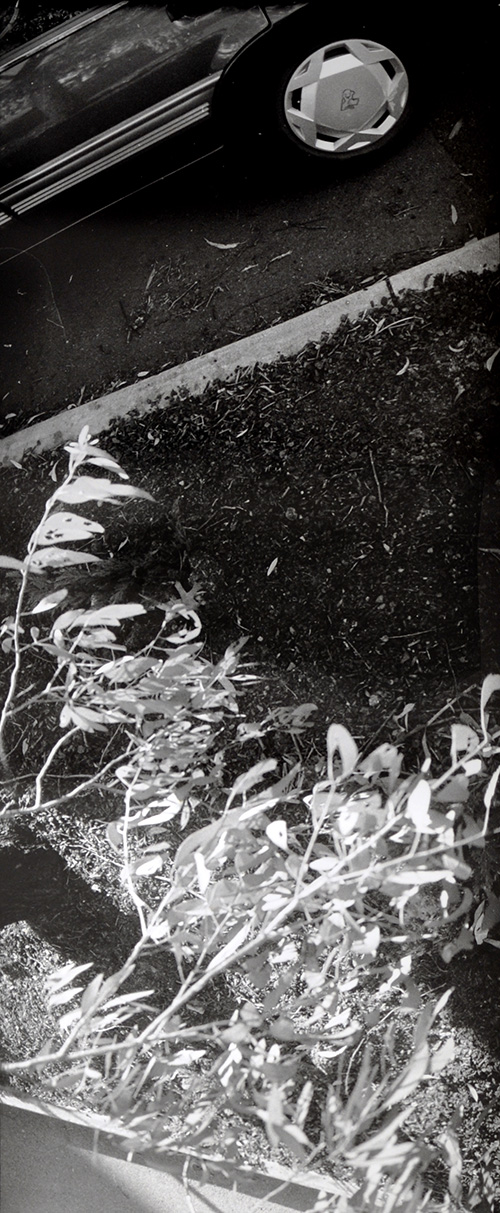
'Holden' by Joyce Evans, part of her series 'The Edge of the road'.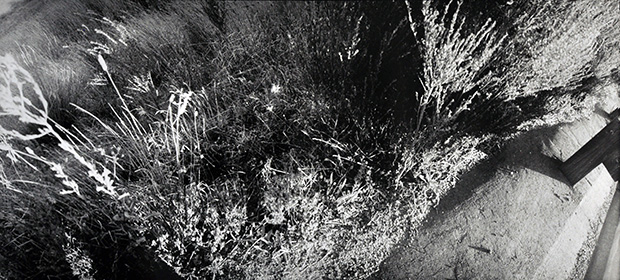
'Wilcannia White Cilffs Road' by Joyce Evans.